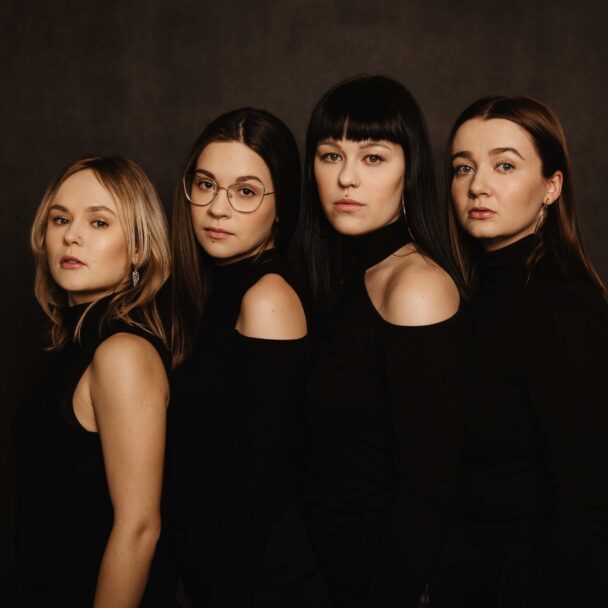
To mark the release of their first album, the Cohaere ensemble offers us an in-depth and sincere reflection on their artistic process, their group dynamics, and the issues currently facing the world of early music. We look back with Monika on what has changed – artistically, personally, and collectively.

💬 What has this recording experience brought you as a group ?
In a broader sense, the recording process was a very important step for us, both as a group and as individuals. As a group, it taught us a lot about discipline, patience, and trust. Preparing for the recording made us realise that every detail matters – not only the technical side of playing, but also how we listen to one another, how we communicate, and how we build a shared artistic vision. Recording is a very exposing experience, because suddenly everything becomes much more precise and audible, so it pushed us to become more conscious and demanding in a positive way.
On a personal level, I think it was also a moment of growth. It confronted each of us with our own habits, strengths, and insecurities. We even shared a conversation about our personal pros and cons and how we can work with that and secure ourselves. With the microphones, you cannot hide behind energy alone - you need focus and consistency. That experience helped us better understand ourselves as musicians and what each person brings to the group.
In terms of internal dynamics, the process strengthened our sense of collaboration. We had to learn when to insist on an idea and when to let go for the sake of the whole thing. It made our discussions more concrete and, in a way, more mature. We became more attentive to each other’s perspectives, and that created a stronger sense of unity.
As for our approach to the repertoire, recording changed it significantly. It made us look at the pieces not only as material to perform, but as something to shape in depth – in terms of structure, color, timing, character, and meaning. We started asking ourselves more precise questions: what exactly do we want to say with this music, what atmosphere do we want to create, and what really deserves to remain essential. It is crucial, because playing live music in concert is ruled with very different principles. So overall, the experience gave us not only a finished album, but also a deeper artistic awareness and better communication in the ensemble.
© Bertrand Pichène
💬 With the benefit of hindsight, how do you perceive the impact of your various recordings on the ensemble ? Have they already had concrete effects?
If we look back a few month, we see those recordings as two distinct chapters in our development. The CD made in Ambronay was, in many ways, a luxury in itself — everything was incredibly well organized and essentially taken care of for us, so we could focus entirely on the music. For a debut recording, which is already quite a stressful and demanding experience, that kind of support made a huge difference. Even though most of us had previous experience with recording CDs, we had never gone through this process together in our small ensemble, so there was still a sense of the unknown. Thankfully, we were guided by a wonderful artistic director, Christoph Martin Frommen, who led us through the process with great calm and understanding. It also meant a lot to have a few familiar faces from the CCR d’Ambronay staff around us – thank you for your support! Compared to our next CD, it was a completely different experience. We organized everything by ourselves: writing the project, organizing people, instruments, hall, travels etc. It was of course a very important experience.
In terms of impact, the first recording opened important doors for us - it helped us gain visibility, connect with new audiences, and build initial recognition. The second one consolidated that momentum and allowed us to go deeper artistically, which also translated into more specific opportunities and collaborations.
Some of these effects were in line with our expectations, especially in terms of exposure, but others were quite unexpected – particularly the way certain networks and invitations developed over time. Looking back, both recordings played complementary roles: one as a starting point, the other as a step forward in defining who we are.
💬 How have you been considering the notion of sustainability in the production of the CD in Ambronay ?
This is something we are becoming increasingly aware of as an ensemble. At the time of the recording, sustainability was not the central starting point of the project, especially given that it was our debut and we were primarily focused on the artistic and practical aspects of the process.
That said, working in a well-organized environment did allow for a certain level of efficiency – particularly in terms of time management and reducing unnecessary stress or travel complications. These are elements that, in hindsight, we also recognize as part of a more sustainable way of working.
Since then, this experience has encouraged us to reflect more consciously on our practices – from how we plan travel and rehearsals to the way we approach production processes. This is an ongoing learning curve rather than a fixed strategy, but we are increasingly interested in finding ways to make our work more responsible, both environmentally and in terms of working conditions.

© Bertrand Pichène
💬 Was there a highlight moment or a memorable anecdote from these recording days?
Perhaps the most memorable moments were the first and the last. Hearing ourselves for the first time through Christoph’s speakers was genuinely thrilling. And when it was all over, it became quite emotional - a quiet sadness that something so intense had already come to an end.
💬 What would you do differently if you were to make the recording today?
Nothing - and that is part of the process. Could some things have been delivered better? Perhaps. But this is who we were at that moment, and that is precisely what gives us the drive to grow and work better.
Our album of Pierre Gaultier’s music captures who we were in March 2025. Recording is a long process of preparation, but everything ultimately converges in that single moment when someone clicks REC. The eyes of focus, the delicate smile, noticing every inch of body movement, hearing every little breath, every little noise. Recording always tells a story – personal story with hope of understanding and taking listeners on a journey to another world for a moment…
By Barthod Maude