Over three days, eight musicians from Ukraine, France, the Netherlands, and Switzerland worked on vocality in works by major Baroque composers (Handel, Vivaldi, etc.) through collective workshops and individual coaching.
Among them, we spoke with Konstantyn and Denys, both Ukrainian musicians, who shared insights into their journeys, their practice of early music in Ukraine, and what it represents for them in the current context.
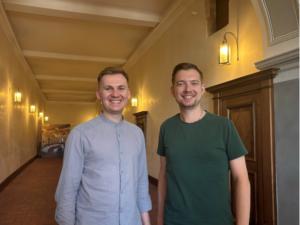
Could you introduce yourselves and share how music entered your lives? What was your training path, and where are you now in your careers ?
Konstantyn : My musical journey began at age of eight when I entered my city’s music school. I continued my studies at the Music College and then at the National Music Academy of Ukraine, where I earned a master’s degree and secured a position as an assistant choir conducting professor. My training spanned nineteen years: eight in school, four at college, and seven at the academy, alongside vocal and piano studies.
This extensive path provided me with solid training and enabled me to become a choir conductor at the National House of Music of Ukraine, the national organization where I currently work. It brings together a choral ensemble, a baroque music ensemble, and numerous soloists, pianists, and organists.
Within this organization, I also perform as a soloist and musician in our early music ensemble, PARTES. It was the non-governmental organization Open Opera Ukraine that gave me the opportunity to develop as a singer within a baroque ensemble, an experience that allowed me to refine my skills in this field.
Denys : I’m Denys. In 2010, I obtained a junior specialist diploma from the Kobzar Art School, dedicated to our national instrument. I continued my training for a total of fifteen years, ultimately earning a master’s degree from the National Music Academy of Ukraine. It was during my studies that I began singing in local ensembles, partly to support myself.
Afterward, for fourteen years, I was a solo singer with the Academic Ensemble of Song and Dance of the Armed Forces of Ukraine.
For the past three years, I have worked as a solo singer, both in choir and solo capacities, at the National House of Music of Ukraine. It was there that my deep interest in early music emerged. My first Baroque solo was Bach, a repertoire I initially didn’t know how to approach. Today, I have acquired far more skills: this experience taught me how to sing this repertoire and helped my voice progress.
Do you remember your first experience with Baroque music?
Konstantyn : Yes, I remember it very well. It was six years ago at the National Philharmonic in Kyiv. I was singing Ukrainian Baroque music with the Kyiv Chamber Choir. I loved that experience. Afterward, I began working with opera singers on pieces by Johann Sebastian Bach and Handel.
Bach remains a true foundation for me: it’s hard to do without him. I studied him both in school and at the academy, playing many pieces on the piano, including the twenty-four preludes and fugues. I believe it’s an essential cornerstone for any professional musician. Even today, I listen to a lot of Baroque music: Rameau, Handel, Bach…
Denys : For me, it was also a lot of Ukrainian Baroque music. With Open Opera Ukraine, we recorded several albums dedicated to this repertoire. We are also preparing, this Autumn, the recording of Dmytro Bortniansky’s opera. It’s not strictly Baroque, more Classical, but we wanted to record it.
What was the historical impact and importance of Baroque music in Ukraine?
Konstantyn : It’s very important because it’s our foundation, our basis. We have a long history of Baroque music in Ukraine. There is a tradition of Ukrainian cants (songs) in Baroque style. The two upper voices move in parallel thirds, while the bass serves as a basso continuo. And then there are the partes concerts – concerts for twelve, eight, or sixteen voices by Mykola Dyletsky, Andriy Rachynsky and other anonymous composers: this is an important choral repertoire, more developed than the instrumental repertoire.
We sing only a cappella because we have an Orthodox tradition in Ukraine, and our Baroque music is based on this liturgical tradition, which does not use instruments.
What about your relationship with traditional music? Are folk songs as vibrant in Ukraine as they might be in the Baltic countries?
Konstantyn: Folk songs are very popular here; we have many in Ukraine. However, it’s important to distinguish this tradition from Baroque singing: it’s not the same approach to early music; the folk tradition remains much more open.
Baroque singing only became a professional practice in Ukraine more than 20 years ago. Before that, under the Soviet Union, we couldn’t develop our own Ukrainian Baroque music: we were told it was nationalistic, and didn’t fit within the Soviet framework. Today, we are reconnecting with this music, with our tradition, bringing a fresh perspective to this heritage.
Preserving and keeping it alive is particularly important today, especially in Ukraine.
Tell us about the early music sector in Ukraine. How is it taught and practiced today ?
Konstantyn : The early music ecosystem in Ukraine continues to develop, despite the same challenges faced by musicians and the cultural sector across the country. On one hand, there is a permanent crisis and a lack of access to professional training. On the other, there is a clear awareness of the need to keep working and planning for the long term. Any other approach would mean accepting surrender and defeat: precisely what the aggressor state wants.
This is why the Kyiv Baroque Fest was launched in Kyiv: an international festival where Ukrainian musicians collaborate with their European colleagues. We are very grateful to all the musicians who have already participated in the festival in 2024 and 2025, including Jean Rondeau, Salomé Gasselin, Andreas Scholl, Hana Blažíková, Marek Toporowski, and many others. This year, we are delighted to welcome Norbert Rodenkirchen, Benjamin Bagby, Giovanna Barbieri, and other musicians.
Open Opera Ukraine has been dedicated for several years to researching and recording Ukrainian musical heritage. This includes partes singing (four albums; note that the album “Concordacii Animos” received the REMA award for the Best heritage project), the music of Maksym Berezovsky, and that of Dmytro Bortniansky. We are currently working on one of his operas, which will be recorded this Autumn.
Since 2026, Open Opera Ukraine has been a member of the REMA network, a step motivated by the awareness of a shared pan-European context and common challenges.
We are ready to share our experience of working in a crisis context, while recognizing that the Ukrainian early music scene remains relatively unknown in Europe. We consider it our mission to make our work known.
What does it mean today to be a professional musician in Ukraine ?
Konstantyn : As you know, the Russian aggression has brought much suffering to our country. Working professionally today is extremely delicate due to constant risks to our lives and mental health. Our concerts are often interrupted by air raid alerts, forcing us to take shelter until the danger passes, or to continue singing underground, as a group.
After night attacks, it’s very difficult to go to work in the morning: we sleep four or five hours and then have to get on stage. Sometimes there is no electricity or transport. We must adapt to this situation and continue creating something new, to improve our skills, keep our music alive, and represent it.
It’s difficult, but we adapt because that’s life.
Do you feel you have a civic responsibility in this context ?
Konstantyn : Yes, it’s our work. We can do it, and we want to do it, and it helps people: for two or three hours, they can see and listen to beautiful music and forget, for a moment, what’s happening outside.
It’s good for health. It provides motivation. Ukraine is us.
You mentioned mental health and health in general. How, in your view, does music contribute to better well-being, for yourselves, your loved ones, and the public ?
Konstantyn : When we sing or work, it distances us from this situation. We become absorbed in the performance: we read the texts, think about the music, the scenes, the theme. We forget the situation, unless the alert doesn’t stop us, but in this case we keep working anyway. I think music is a key to relaxation. Music is like a remedy, like medicine.
It creates a kind of bubble where we can transcend, together with the audience, in something more calm than what’s happening outside.
Is there a topic we haven’t covered that you’d like to share?
Konstantyn: We want to thank you for your support, in Europe, and in France in particular, because it’s very important for us that we are not alone. It is very rewarding to know that Europe understands – this war is not only about Ukraine, it’s about our common values, about the defense of democracy, freedom and justice. We have friends and colleagues here; we are fortunate to belong to a large professional community. Your support means a great deal to us. And we will take back to Ukraine the knowledge, inspiration, and unforgettable emotions we have gained here.
Thank you very much for that.