On 29 and 30 June 2026, the Centre culturel de rencontre d’Ambronay (CCR) hosted a S-EEEMERGING Lab exploring the intersection of music and disability. Maria Danneberg, a viol player with the Austrian ensemble Freymut, supported by the European Sustainable-EEEMERGING programme in 2024–2025, was invited to take part in the first two-day session.
The Lab explores how artistic activities can be accessible, drawing on the expertise of several specialist partners. These include Résonance Contemporaine, a professional music organisation dedicated to musical creation through Les Percussions de Treffort and the Ensemble de SixVoix Solistes, as well as the Centre de formation des musiciens intervenants (CFMI), which trains musicians to lead music-awareness programmes in schools and specialist settings. On/Off, a company recognised regionally for its work in Deaf arts and French Sign Language, will join the project for the September session.
The first session drew inspiration from the work of Fernando Oreste Nannetti, a patient at the psychiatric hospital in Volterra, Italy. Over nearly nine years, using the metal clasp of his belt, he engraved a monumental, 70-metre-long work across the walls of the institution’s inner courtyard.
Starting from this gesture and its story, the artists were invited to explore collective creative work while immersing themselves in Ambronay Abbey. How can we inhabit a place while respecting its constraints and, through music, build a meaningful, sensory connection with audiences with disabilities?
Maria, viol player with the Ensemble Freymut and member of the EEEMERGING community
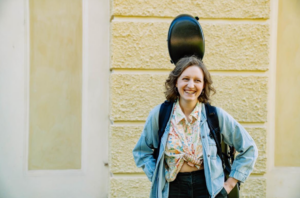
The first day offered Maria several opportunities for discussion: with CFMI students attending the Lab, and in individual meetings with Sébastien Eglème, musician and head of the ‘Diplôme universitaire de musicien intervenant’ programme at CFMI Lyon 2; Marina Roche-Lecca, Director of the Territory and Participation department at CCR d’Ambronay; and Alain Goudard, Artistic Director of Résonance Contemporaine and Les Percussions de Treffort.
The second day began with a musical walk through the abbey grounds, followed in the afternoon by a round-table discussion bringing together artists and professionals to explore questions of accessibility.
At the end of these two days, we spoke with Maria about what she experienced and discovered, and the ideas she now hopes to pursue. (Her answers are translated to English!)
What led you to take part in this S-EEE Lab?
“When I saw that Ambronay was offering an opportunity to take part in something individually, it immediately caught my attention. I usually take part in most events with my ensemble, but very rarely on my own. When I saw the announcement, I immediately recognised it as an opportunity to get involved in EEEMERGING as an individual artist.
The theme was another major motivation, as it is something I care deeply about. In France, a great deal of work is already being done on these issues, whereas in Austria, the field is much less developed. What I discovered here really opened my eyes. As artists, we sometimes ask ourselves: What do I actually want to achieve through my music? What is its purpose? After these two days, I feel I have begun to find some answers.”
Is there a particular purpose you want to give to your artistic practice?
“Last November, when my ensemble and I came here, we took part in a coaching session with Isabelle Battioni. She explained that in France, it is possible to apply for funding for projects with a social impact. I remember thinking: “That’s it! This makes sense, and it gives meaning to what I want to do!”
What my ensemble and I want to do is use music to bring about change and make sure that our work has a real impact.
Doing things for a reason: that is what matters most to me, both as an individual and as part of my ensemble.”
What made the strongest impression on you during these two days?
“One thing that really struck me was how the shared theme brought the whole experience together. Every workshop and every contribution connected with the others, as though everyone were working along the same thread.
One particular exercise also left a strong impression on me. It involved collective coordination through a simple sound-based gesture: several people had to reproduce a movement initiated by one person, without any verbal instructions being given.
I found myself wondering how we could coordinate in this way, without anyone explaining what to do and without any hierarchy between those who know and those who don’t.
And then you realise that we don’t always need words. Sometimes, all it takes is looking at one another, making a gesture, and listening through our eyes, through sounds or through music. It happens naturally. As soon as someone in the group starts something, everyone follows, and a collective dynamic begins to emerge.”
The Lab also gave you the opportunity to meet a number of professionals and artists. Are there any encounters you would particularly like to share?
“I was incredibly fortunate to have individual conversations with several of the people involved, and every one of them gave me something valuable. But one conversation was particularly special. Alain Goudard and I spent two hours talking together. I was fascinated by his energy, and the time we shared was precious to me. It was a genuine exchange.
I was able to share my artistic ideas and develop my thinking, ask him lots of questions about his career, and get his perspective on the projects I’m currently considering.
I also made a point of talking to all the artists from the CFMI and exchanging ideas with them. Those conversations were very rich, too. All these encounters were deeply enriching, inspiring and human.”
Are you leaving with a particular desire to explore new directions?
“Absolutely, so many! I’ve wanted to create a solo project for a long time. It’s something I’ve been developing in my mind for the past two years. I’ve already started recording sounds and learning how to edit them.
I’m now leaving this experience with so many new ideas. This Lab came at exactly the right time for me, both in terms of my thinking and my artistic practice, as I develop this future solo project. It has also had an impact on me personally. I’ve been nourished by everything I’ve seen here, but also by everything people have shared with me.
It also resonates with a project I’m involved in back home in Vienna. There’s a festival where the main concert takes place in a courtyard overlooked by the windows of a health and social care centre that welcomes people with disabilities. Managing the relationship between the festival and the centre isn’t always straightforward, so I discussed it with Alain Goudard, and we explored alternative ways of approaching this proximity.
Rather than seeing it as a constraint, why not work with the residents?
He had a wonderful idea: invite someone to share a memory they cherish and record it, then use that material to write texts from which the musicians could create something.
It could completely change the perspective: “Come in, join us, the musicians are creating something with you.”. It gave me so many ideas.”
If you had to sum up these two days in one word, one sentence or one image, what would it be?
“I think it would be the power of exchange and the perspectives it opens up: becoming curious again, allowing yourself to be enriched by new opportunities, and learning to see things differently. And perhaps, quite simply, letting things unfold.
It was an enriching experience on every level, both professionally and personally. You learn things you don’t necessarily encounter in everyday life. We don’t always think about how differently people experience music depending on their individual circumstances and disabilities. It really brings you back down to earth.
Usually, we’re fairly confident in our own opinions. But here, perhaps the most important thing I learned is that it’s not just about us. There are so many other people, ideas and resources that can help us, if we’re willing to learn from them.
The experience challenged some of my assumptions, in the best possible way. There is still so much to learn and so many ideas to develop.
I think that’s what Sustainable-EEEMERGING is all about, in the end: the programme helps us step outside our habits, bring new perspectives into our practice and keep pushing ourselves further. It takes time to discover what we truly want to share, and that’s exactly the kind of space this programme gives us.“